
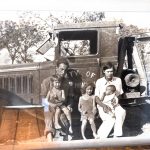

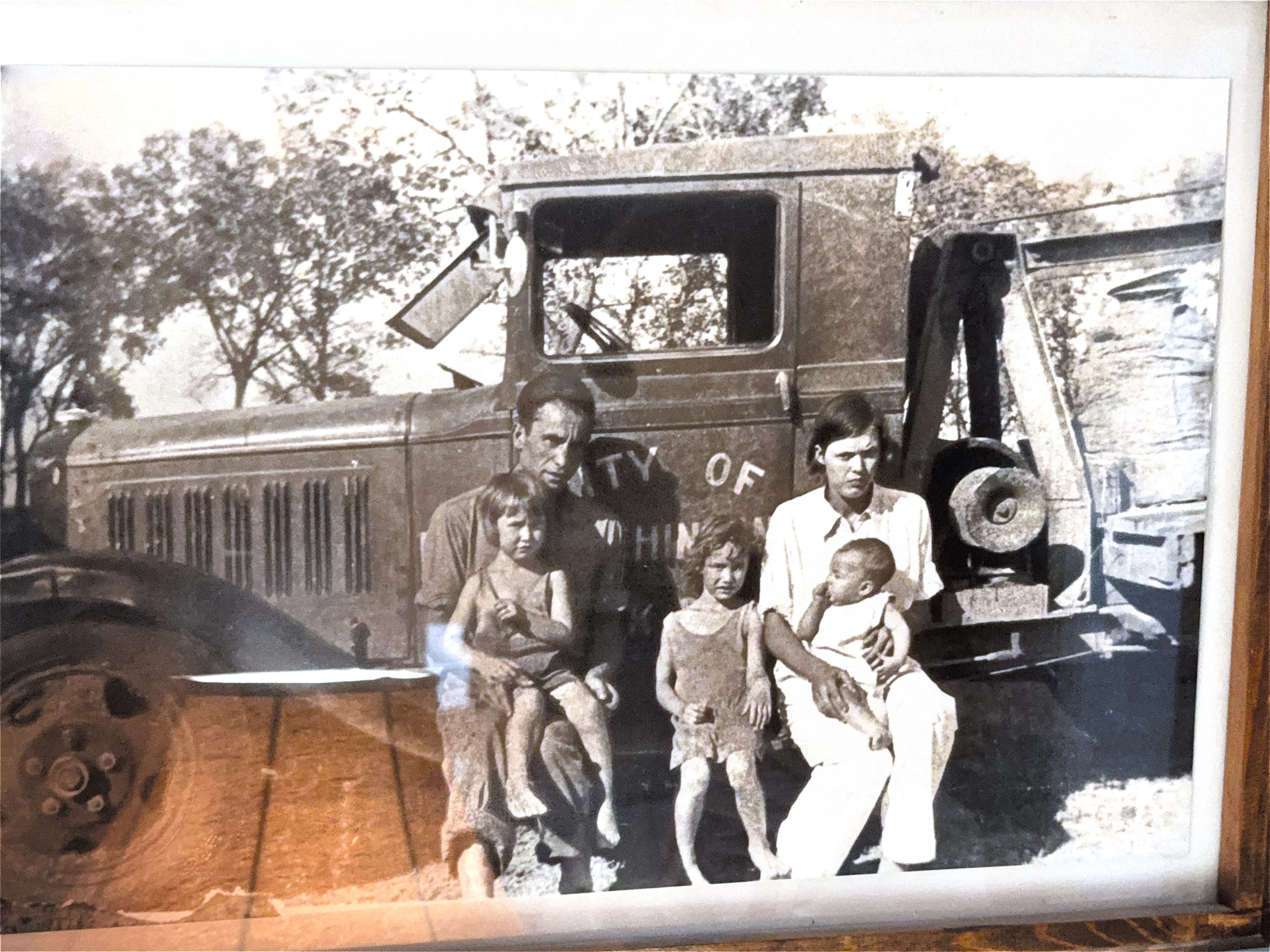

I was meditating on the black and white photo of my mother as an infant that hangs in my living room. It has been a cultural landmark in every place in which I have lived or worked since I first had it blown up and framed in 1981, alongside a similarly iconic photo of my father. There was one other, of my then mother-in-law as a teenager. I gave that one away when I returned her son after 23 less than blissful years. The story and secrets held in that picture are no longer part of my heritage to ponder or share – although my love for it and the woman it represented remains a part of who I am.
Old photos hold mysteries inside of mysteries, revealing only what can be seen in that moment, with that lens, within the frame of its narrow focus. What came before, after, or was happening beyond its capture of reality will be remembered differently by those who were present, and can only be guessed at by those who were not.
My mother is sitting on the lap of her mother, on the running board of a large WPA truck, with her barefoot sisters in rough cotton clothes, and her father alongside. Only my grandmother and mother look like their clothes were clean that day. My grandmother’s shirt and pants are overlarge and ill-fitting, and unexpected when you think of the way women were expected to dress. My grandmother is young, and looks very, very angry – miserable even. My grandfather looks a lot older than my grandmother, and his skin is dark and weathered. My one aunt looks like she was called away from playing in the dirt, and the other looks like she expects a whipping after the camera shutter clicks. Nobody is smiling. Everyone looks tired. I call it my “Grapes of Wrath” picture. They look exactly like the dirt-poor people they were, overcoming the devastation of the Great Depression and Dust Bowl in rural Kansas.
The family oral history is that my grandfather was working to build one of the dams that were meant to create lakes and fill lakes. There are enough letters on the side of the truck that are visible behind the irritable subjects in the photo to make out it was a government-owned truck in the city known to be home base of that story. That tracks.
But oral history doesn’t fully match the research. There are gaps. There wasn’t any dam built near the City of Hutchinson by WPA – but there was a viaduct – so I think he was working on the cross-over of Cow Creek – a viaduct, not a dam. Cow Creek was a fixture in my childhood, but it would have loomed much larger in my memory had I known that. As it was, the WPA projects mattered more to me in history than most of my classmates, because I percieved it as my history.
It wasn’t nameless people whose survival depended on those projects – I existed because they existed. That baby survived because they could feed her, house her, care for her, even if the stories of all of that are a harsh, ugly reality that also had to be survived by her for me to be.
The WPA projects were much more than dams and viaducts, although that’s all I remember hearing about in school. In of itself, WPA was a brilliant way to employ 8.5 million people and work our country out of economic collapse, and dams are turning out to be a longterm environmental problem instead of the solution that would end future devastation to farmlands and rural towns they were meant to be. Expect more as a likely post for the future.
Depression and Oppression – the moon and the sun of my family’s cultural identity.
I use visual cues for meditation exercises, when the musical or verbal cues, or the written prompts and poems are drowning out my inner peace, and I just want my own voice in my head. Sometimes, I look at nature. Sometimes, like today, I look at one of the paintings, posters, and photos that adorn my environment, and I daydream. If the meditation is meant to trigger a decision, or give me clarity over a struggle I’m having, frequently, I will pull tarot cards from one of the many decks I own. Sometimes, I just imagine pulling a card and visualize it. Kids freak out when I ask them to pull 3 cards from my invisible deck. Then I give them a reading that blows their minds some more. It’s not witchcraft…really not. It’s psychology and social science.
Tarot ascribes specific meaning to the card’s symbols, which people who are not adept in their use can get all tangled up in. A future ex-daughter-in-law of mine believed that I had somehow cursed her and caused the death of her mother by reluctantly doing a reading for her over the phone, before I ever met her. If I had the ability to do what she imagined I had done, I would have prevented that marriage from ever happening – so, obviously I was not the evil and powerful being she imagined, and her preacher did not need to give my son a lecture at their wedding about breaking away from his mom. Wow. Right? Clearly, whatever phenomenon causes me to infrequently share random spot-on moments of insight into future circumstances is not an act of intention, and I would never make decisions based on the belief I can predict the future. Also, fortune-telling it’s not how I use tarot. It is true that Tarot regularly uncovers hidden truths – not because the cards or the reader possesses supernatural power to predict the future or read minds. It’s science people, not magic.
Our mind works in symbols and interprets the information that flows to it from all of our senses, and filters it through stored memories to categorize, compare, and ultimately “know” things.
I had remarked to my eldest daughter, Era, that it is sometimes difficult for me to reconcile my sun and my moon. The sun card in tarot represents the external, the moon is the internal. Both represent powerful forces – but the sun represents outward directed energies (masculine energy) and the moon represents inward directed energies (feminine energy). In other symbolic reads, like astrology, the moon represents how one feels about oneself – and the sun is what others perceive.
Looking at the picture on the wall, I see how family identity comes from moon energy, the story we tell our children about their people and how we belong to an oral history that shapes our world view. That history usually runs through the stories that are the most illustrative of the values we pass down, the most fascinating to hear, the most fun and dramatic to tell – of heroes and villains and great deeds and calamities. My family’s narrative on identity focuses on the tiny segments that we share with the oppressed people who overcame tragedy and persecution with intelligence, creativity, and wit. We are pretty people, by and large, and smart, and funny, and we are not like most of the people around us. That personality trait is one that is easy to trace through genealogy, but not biology.
When you grow up hearing your whole life that your grandparents were not white, and you have photographic evidence that kind of supports that – it is difficult to come to terms with the fact that the biological evidence of that inheritance washes away as generations pass, even though it is part of your core truth – your moon of being.
I have traced our genealogy – which supports all the claims. We are Melungeon, we come from multiple North American Tribes and African and Carribe aboriginal stock, and French, and Spanish, and Irish, and English, and Swedish, Danish, Eastern Europe, and Italian, and Scandinavian, and Russian, and Ukrainian, and North African, and Vikings, and Irish, and Scottish, and English, and Ashkenazi, and Celts, and Picts, etc., etc., etc. But that’s not the majority of the DNA that shows up in the current generation. It’s almost too small to find, in fact, and can be eliminated or revised every time a new study narrows the relationships between one haplogroup and its geographical origin.
In the same vein, the proud Irish heritage that my father claimed as his primary identity doesn’t show up as more than 5% of my DNA. It is more in some of my siblings, but nowhere near a third. He would have been appalled to learn that he must have been mostly English. Both of my parents would have been shocked to hear their people came from the oppressor class, the wealthy conquerors and occupiers, and imperialists. But I know my Dad’s family would have been shocked to learn that my mother is closer to royalty than they are, in recency and number of connections – and the non-european heritage he said my mother had is part of his ancestry too, even if less and further away in time – with probably a less courageous backstory to it. But the stories of my family’s oral history still ring true – the villains and the heroes were large and loud and their actions were sometimes world-changing, and their stories are fascinating and fun to tell. They were pretty people, smart, funny, clever, inventive, creative, and scandalous – exactly like my family. Oppressors and oppressed, survivors of depression with both a small and large D, a resilient lot.
So, yes. I am not who I am, and I never will be. My moon and my sun are in a constant state of eclipse in the internal dialogue that makes up my identity. But I think that’s kind of normal. Don’t you?